Monday, 21 May 2012

INTRODUCTION TO AYURVEDA 2: DISCOVER YOUR MIND-BODY TYPE


At Christchurch, Clarendon Park, for the second session in the course, "Introduction to Ayurveda", offered by Christians Aware as part of their Faith Awareness programme.

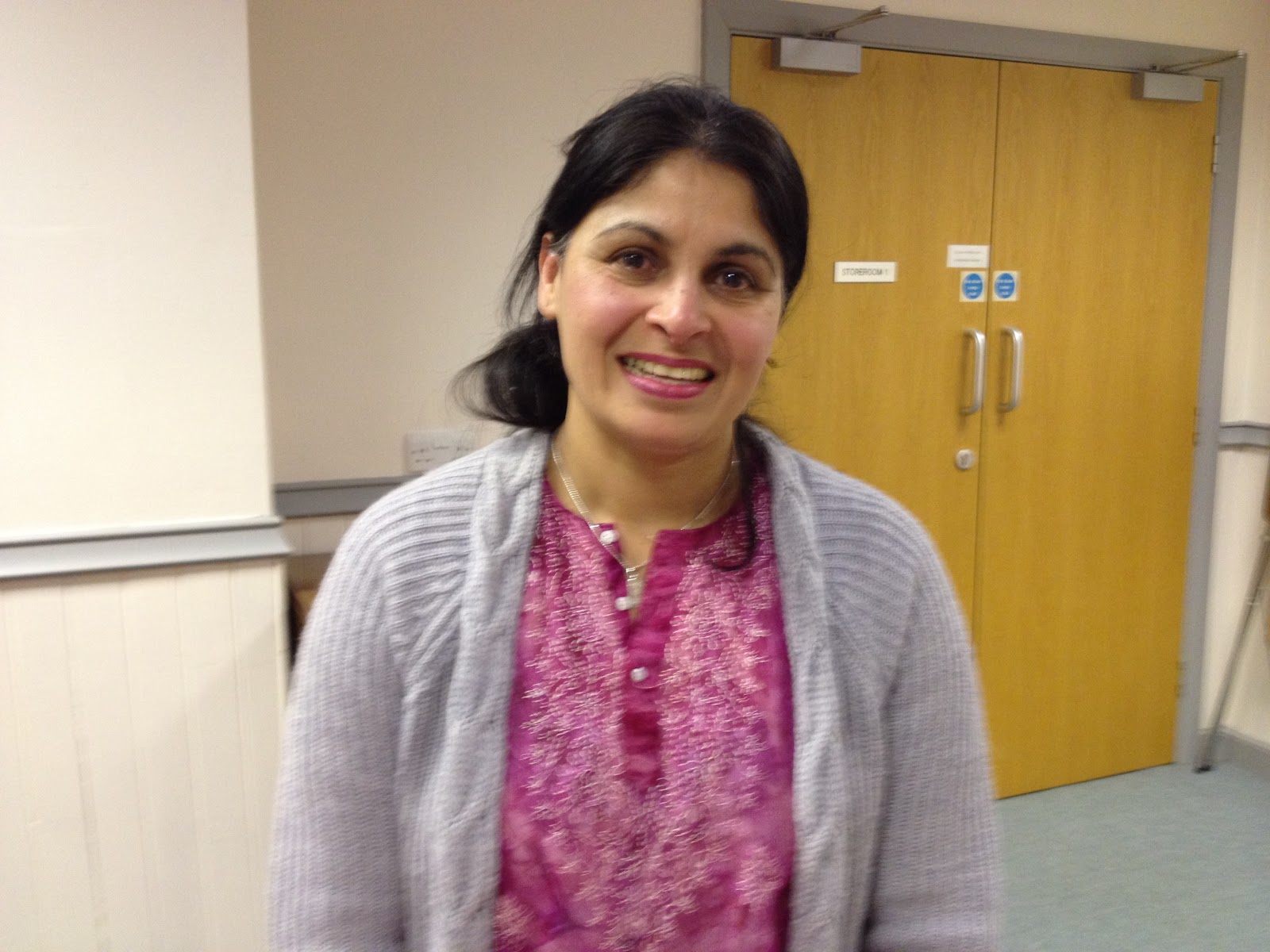
This evening, course leader Neena Joshi is joined by Dr Dave (photo above), who presents most of the session. Dr Dave worked within the NHS as a gynaecologist at Leicester Royal Infirmary for ten years, then as a GP with a practice off the Narborough Road. Now retired, he's following in the footsteps of his father, who was an Ayurvedic practitioner. Dr Dave's lengthy professional experience and deep knowledge allow him to make meaningful comparisons between allopathic and Ayurvedic medicine.

The goal of Ayurveda is to establish and maintain internal equilibrium. There are three ways in which this desired equilibrium may be disturbed: of external physical origin; of internal physical origin; and of mental origin. In Ayurveda, the mind is the root, seat and origin of all conditions, good and bad. Therefore, control of the mind is the first and most effective step in controlling the body. The mind cannot be controlled by the mind itself, but it can be influenced by control of the breath. At the end of the session, Neena leads us through a short exercise of alternate nostril breathing to demonstrate this effect on the mind. She also gives us homework: a sheet listing characteristics, internal and external, which would help each of us determine our own dosha - our mind-body type. We should all have a go at this before we meet up again for the next session.

As we're breaking up, I make an appeal for volunteers to take part in our Faith Communities Health Champions project with Leicestershire Partnership NHS Trust. I'd like to have a few people who have a lively personal interest in non-conventional medical treatment. It seems like I might have a few willing participants from this evening's group.

Monday, 14 May 2012

INTRODUCTION TO AYURVEDA 1: AYURVEDA & HEALTH


At Christchurch, Clarendon Park, for the first session in a new course, "Introduction to Ayurveda", offered by Christians Aware as part of their Faith Awareness programme.

The five-week course (interrupted by holidays on two successive Mondays) is led by Neena Joshi (photo above), who runs yoga classes locally, as well as being involved in Leicester’s Art of Living centre. There are 38 Art of Living centres throughout England (25 of them outside London).


Neena introduces us to many technical terms this evening, some of which will be more clearly defined as we progress through the course. As far as this introductory session goes, probably the most important one to grasp is the meaning of Ayurveda itself: Ayur means "life", Veda means "knowledge".

After being immersed in a lot of theory, Neena closes the session by leading us through a quarter of an hour of breathing and movment practice, to relax the body and calm the mind.

Monday, 5 March 2012

MINDFULNESS & WISDOM 8: IN CONCLUSION

At ChristChurch, Clarendon Park, for the final session in the course, "Mindfulness". This eight-week course is an interfaith opportunity presented by Christians Aware (as part of its Faith Awareness programme) in association with Leicester Serene Reflection Meditation Group.

This concluding session is facilitated by Ian Grayling and Kevin Commons, from the Serene Reflection Group.


Part of this evening is devoted to considering similarities and differences between the presentations that we've had in previous weeks. 

From the three introductory sessions
People may well be at different stages of faith where for some the principal locus of authority is external (teachers and scriptures) but for others the principal locus of authority is found within. This is underpinned by a sense of progression through life from Dependence, though Independence to Interdependence.

Zen Buddhism Wisdom and Compassion are inextricably linked.

Islam Wisdom is expressed in your actions.

Judeo-Christian The scriptures provide insight in how to lead the good life.  In this regard is Jesus a window into Wisdom?

Humanist Wisdom is about deciding what is right to do at an individual, family and societal level.

Similarities If wisdom is not manifested in daily life it is not wisdom. What you think, believe and say should be compatible with what you do.

Differences The Zen contribution made much more of the importance of direct personal experience that goes beyond rationality but is still relevant to daily life.

Monday, 27 February 2012

MINDFULNESS & WISDOM 7: THE PLACE OF WISDOM IN THE HUMANIST TRADITION


At ChristChurch, Clarendon Park, for the seventh session in the course, "Mindfulness". This eight-week course is an interfaith opportunity presented by Christians Aware (as part of its Faith Awareness programme) in association with Leicester Serene Reflection Meditation Group.


Our topic this evening is "The Place of Wisdom in the Humanist Tradition", presented by Dr Allan Hayes. Allan studied mathematics at Trinity College Cambridge (BA, PhD).  Retired from an academic career, in which he taught at Massachusetts Institute of Technology (MIT), Purdue University, Leicester University and De Montfort University, he is now a Director of Leicester Secular Society and a Trustee of the Sea of Faith Network and of the British Humanist Association.
Allan discusses the wisdom of Proverbs and of Jesus as recorded in the Gospels and makes a case for their value as human-created, human-centred sources of wisdom, without the need to appeal to supernatural origin. When asked to clarify what he means by "supernatural", Allan defines it (without recourse to any text) as "an agency with intention, acting with its own purpose, that is outside the normal discourse of science."
Allan refers to two books, published within a year of each other, which illustrate opposite ends of the spectrum of belief: Don Cupitt's Jesus and Philosophy (London: SCM Press, 2009), in which the author presents Jesus as a radical humanist and John Shelby Spong's Jesus for the Non-Religious (New York: HarperOne, 2008), in which the author argues that Jesus is such an extraordinary figure, he must be divine.

Monday, 20 February 2012

MINDFULNESS & WISDOM 6: THE PLACE OF WISDOM IN THE JUDEO-CHRISTIAN TRADITION


At ChristChurch, Clarendon Park, for the sixth session in the course, "Mindfulness". This eight-week course is an interfaith opportunity presented by Christians Aware (as part of its Faith Awareness programme) in association with Leicester Serene Reflection Meditation Group.


Our topic this evening is "The Place of Wisdom in the Judeo-Christian Tradition", presented by Revd Marcus Braybrooke. Marcus is President of the World Congress of Faiths and is the author of many books on religion and spirituality in its many forms. His specialist interest is in relations between Christians and Jews. The copy below is almost entirely adapted from the handout we’re given this evening.

Wisdom literature was commonplace in the Ancient world. Here are a few examples of Ptahotep's advice:
  • "Do not gossip in your neighbourhood, because people love the silent."
  • "Only speak when you have something worth saying."
  • "Love your wife with passion."
  • "Do not blame those who are childless, do not criticise them for not having any, and do not boast about having them yourself."

Wisdom literature in the Bible
The Wisdom literature includes books such as Job, Proverbs, Ecclesiastes and the Song of Solomon and perhaps the Psalms and (in the Apocrypha) The Wisdom of Solomon and Ecclesiasticus, which is the Greek translation of Ben Sirah who wrote the book in Hebrew c. 190/180 BCE and it was then translated into Greek for his grandson in 132 BCE. Wisdom literature in the Bible is of two types: instruction and reflection.


Instruction
Are you good at getting up in the morning? If not, here's one for you: "As the door turns upon its hinges, so doth the slothful turn upon his bed." (Prov 26:13). Again, "The bickerings of a wife are like the ever-dripping gutter." (Prov 19:13). But lest we be accused of sexism, Proverbs also says of a virtuous woman, "her price is above rubies." (Prov 31:10). Sometimes there are parallels with New Testament passages: "The tongue that soothes is a tree of live; the perverse tongue a breaker of hearts." (Prov 15:4) and "With the tongue we praise Our Lord and Father with the tongue we curse man, who hath been made in God's likeness." (James 3:9). There is quite often a suggestion that God will reward the righteous: "Treasures of wickedness profit nothing, but righteousness delivers from death. The Lord will not let the upright go hungry. He thwarts the greed of the wicked." (Prov 10:23). Also, "The righteous man 'shall be like a tree planted by the waterside, but the ungodly are like chaff, which the wind scattereth away from the face of the earth." (Psalm 1)


Reflective literature
Wisdom literature ponders the injustice of life: "God has delivered me to the ungodly, and turned me over into the hands of the wicked. Know now that God hath overthrown me, and has caught me in a net. Behold I cry out of wrong, but I am not heard: I cry aloud but there is no judgement." (Job 19:6-7) The Preacher in Ecclesiastes says: "Vanity of vanities, all is vanity".


The personification of Wisdom (who is female)
Wisdom says in "The Lord brought me forth or created me as the first of his works ... I was appointed from eternity, before the world began." (Prov 8:22)


"wisdom pervades and permeates all things. She is the breath of the power of God, pure emanation of the glory of the Almighty ... She is the reflection of the eternal Light, untarnished mirror of God's active power, and image of his goodness." (Book of Wisdom 7:25-26)

Wisdom gives understanding and teaches the secret of a good lire, which is obey the Torah. Solomon says: "I called upon God, and the spirit of wisdom came to me ... I loved her above health and beauty ... She is a treasure unto men that never fails." (Wis 7:7)


"Thy word is a lantern unto my feet: and a light unto my paths." (Psalm 119:105) 

"Thy testimonies are wonderful: there fore doth my soul keep them." (Psalm 119:129)

Wisdom in the New Testament - Parallels in the Gospels
Wisdom says: "Put your neck under the yoke and let your soul receive instruction: she is hard to find." (Ecclesiasticus 51:26) Jesus says: "Take my yoke upon you and learn of me." (Matthew 11:25) Testing, and the mocking of a servant of God's claim to be protected by God: Let us see if his words are true, and let us test what will happen at the end of his life: for if the righteous man is God's son, he will help him, and will deliver him from the hand of his adversaries." (Wis 2:17-18). "He trusts in God; let God deliver him now, if he desires him; for he said, 'I am the Son of God.'" (??)


The wisdom of God is foolishness to men (1 Cor 1:17ff)
Wisdom is a challenge to human conceit and to a knowledge-based pattern of education.


Jesus as the Wisdom or Word of God
Several New Testament writers identify Jesus with the figure of Wisdom who was with God from the beginning but how close is the parallel?

Paul actually speaks about Christ as "the power of god and the wisdom of God." (1 Cor 1:24) and says that his message was "of the mystery of the wisdom of God - even the hidden wisdom, which God orddainedCor 2:7) "Wisdom is a reflection of eternal light, a spotless mirror of the working of God, and an image of his goodness." (Wis 7:26) The author of Hebrews says of Christ: "He reflects the glory of God and hears the very stamp of his nature, upholding the universe by his word of power." (Prologue to John's Gospel)


Later Judaism
Rabbinic Judaism said little about Wisdom, but she reappears in Kabbala or mystical Judaism.


"How should we speak of Jesus?"
Some translations of the New Testament avoid "Father" and "Son".

"Stories of the Prophets", and Arabic Bible that uses "Lord" instead of "Father" and "Messiah" instead of "Son".

"True Meaning of the Gospel of Christ", an Arabic translation which removes "Father" in reference to God and removes or redefines "Son".

A Turkish translation of Matthew that uses "guardian" for "Father" and "representative" or "proxy" for "Son".

The Bengali Infil Sharif, which translated "Son" as "Messiah" and "Son of God" as "God's Uniquely Intimate Beloved Chosen One"
We're given an exercise for our small group work that seems a little odd, given that not everyone in the room is Christian (we have at least two Secular Humanists, two Buddhists and a Bahá'í) but everyone does their best to enter into the spirit of things. We're asked to discuss the most helpful way to speak of God's presence in Jesus:
  • Jesus is God
  • Jesus is the Image of God
  • God was in Jesus Christ
  • Very God of Very God
  • The Wisdom or Word of God was present in Jesus and also in Buddha and Zoroaster and Krishna
  • Jesus as a window into God (which is how he is described in Honest to God)

Monday, 13 February 2012

MINDFULNESS & WISDOM 5: THE PLACE OF WISDOM IN THE ISLAMIC TRADITION


At ChristChurch, Clarendon Park, for the fifth session in the course, "Mindfulness". This eight-week course is an interfaith opportunity presented by Christians Aware (as part of its Faith Awareness programme) in association with Leicester Serene Reflection Meditation Group.

Our topic this evening is "The Place of Wisdom in the Islamic Tradition", presented by Freda Hussain MBE. Freda is retired Head Teacher at Moat Community College and former Lord Lieutenant of Leicestershire. Her presentation is peppered with illuminating quotations about the significance of wisdom in the Islamic tradition and the importance of knowledge and learning:
"Acquire knowledge, it enables its possessor to distinguish right from wrong. It is our friend in the desert, our company in solitude and companion when friendless. It guides us to happiness, it sustains us in misery, it is an ornament amongst friends and our armour against enemies." (from Hadith - a compilation of sayings ascribed to the Prophet Muhammad)
"A Muslim who plants a tree or sows a field, from which man, birds and animals can eat is committing an act of charity." (Hadith)
"Who are the learned? Those who practise what they know." (Hadith)
"No man is a true believer unless the desires for his brethren, that which he desires for himself." (Hadith)
"There is no greater wealth than wisdom; no greater poverty than ignorance." (from sayings of Imam Ali)
"The teacher who is wise indeed does not bid you into the house of wisdom, but rather leads you to the threshold of your own mind." (Kahlil Gibran)

Our speaker briefly but helpfully discusses the Sufi thread in Islamic thought and culture and how Sufi poetry expresses the wisdom born from that tradition, which is inseparably linked with spiritual yearning and religious ecstasy.


When we do small group work for 20 minutes or so, we're tasked with thinking of a question to put to our speaker. I don't think that even this group is familiar enough with the kind of Islam which has been described this evening to do that. Many of those attending find it hard to reconcile the contemporary image of Islam with the one which Freda has described this evening. She understands this all too well and acknowledges it as the tragedy of modern Islam.


One interesting question is whether there is an movement or stream of thought within the Islamic world comparable to the Sea of Faith Network. Our speaker says that she doubts it.


Freda differentiates between modern Islamist thinking, which appears to revolve around the fear of God, with Sufi thinking, which revolves around the love of God. In this connection, she quotes another saying from the Hadith: "The ink of the scholar is more sacred than the blood of the martyr."


The authoritative, canonical nature of Hadith seem always to be in dispute. As fashions and passions change, so certain sayings can be ruled in or out, giving backing to different worldviews.


We discuss the apparent equivalence of knowledge and wisdom in the quotations used this evening. These are two distinct terms in Arabic ('ilm and hikmat) which are occasionally conflated when translated into English. But over and above these, Freda emphasises the inseparable relation between faith (iman) and action (aman).

Monday, 6 February 2012

MINDFULNESS & WISDOM 4: THE PLACE OF WISDOM IN THE SOTO ZEN BUDDHIST TRADITION


At ChristChurch, Clarendon Park, for the fourth session in the course, "Mindfulness and Wisdom". This eight-week course is an interfaith opportunity presented by Christians Aware (as part of its Faith Awareness programme) in association with Leicester Serene Reflection Meditation Group.


Our topic this evening is “The Place of Wisdom in the Soto Zen Buddhist tradition”, presented by Revd Master Saido Kennaway. Revd Kennaway is a member of the Order of Buddhist Contemplatives. We're grateful to him for having driven here from Telford Buddhist Priory tonight, as the roads are still treacherous in places, with the recent freezing weather.


Wisdom, in a Buddhist sense, combines right understanding and right intention. There is no distinction in the Soto Zen tradition between practice and realisation: it’s not about practising in order to reach enlightenment.

Our speaker refers to five skandhas ("aggregates", "constructs" or “heaps”). The skandhas may be thought of as components that come together to make an individual. Every thing that we think of as "I" is a function of the skandhas. Put another way, we might think of an individual as a process of the skandhas, which may be delineated as follows (explanations taken from About.com.Buddhism):

The first skandha: form (Rupa)
Rupa is form or matter; something material that can be sensed. In early Buddhist literature, rupa includes the Four Great Elements (solidity, fluidity, heat, and motion) and their derivatives. These derivatives are the first five faculties (eye, ear, nose, tongue, body) and the first five corresponding objects (visible form, sound, odor, taste, tangible things). Another way to understand rupa is to think of it as something that resists the probing of the senses. For example, an object has form if it blocks your vision – you can't see what's on the other side of it – or if it blocks your hand from occupying its space.

The second skandha: sensation (Vedana
Vedana is physical or mental sensation that we experience through contact of the six faculties with the external world. In other words, it is the sensation experienced through the contact of eye with visible form, ear with sound, nose with odor, tongue with taste, body with tangible things, mind (manas) with ideas or thoughts. It is particularly important to understand that manas – mind – in the skandhas is a sense organ or faculty, just like an eye or an ear. We tend to think that mind is something like a spirit or soul, but that concept is very out of place in Buddhism. Because vedana is the experience of pleasure or pain, it conditions craving, either to acquire something pleasurable or avoid something painful.

The third skandha: perception (Samjna, or in Pali, Sanna)
Samjna is the faculty that recognizes. Most of what we call thinking fits into the aggregate of samjna. The word "samjna" means "knowledge that puts together." It is the capacity to conceptualize and recognize things by associating them with other things. For example, we recognize shoes as shoes because we associate them with our previous experience with shoes. When we see something for the first time, we invariably flip through our mental index cards to find categories we can associate with the new object. It's a "some kind of tool with a red handle," for example, putting the new thing in the categories "tool" and "red." Or, we might associate an object with its context – we recognize an apparatus as an exercise machine because we see it at the gym.

The fourth Skandha: mental formation (Samskara, or in Pali, Sankhara) 
All volitional actions, good and bad, are included in the aggregate of mental formations. How are actions "mental" formations? Remember the first lines of the dhammapada (Acharya Buddharakkhita translation):
“Mind precedes all mental states. Mind is their chief; they are all mind-wrought. If with an impure mind a person speaks or acts suffering follows him like the wheel that follows the foot of the ox."
“Mind precedes all mental states. Mind is their chief; they are all mind-wrought. If with a pure mind a person speaks or acts happiness follows him like his never-departing shadow.”

The aggregate of mental formations is associated with karma, because volitional acts create karma. Samskara also contains latent karma that conditions our attitudes and predilections. Biases and prejudices belong to this skandha, as do interests and attractions.

The fifth Skandha: consciousness (Vijnana, or in Pali, Vinnana)
Vijnana is a reaction that has one of the six faculties as its basis and one of the six corresponding phenomena as its object. For example, aural consciousness – hearing – has the ear as its basis and a sound as its object. Mental consciousness has the mind (manas) as its basis and an idea or thought as its object. It is important to understand that consciousness depends on the other skandhas and does not exist independently from them. It is an awareness but not a recognition, as recognition is a function of the third skandha. This awareness is not sensation, which is the second skandha. For most of us, this is a different way to think about "consciousness." It is also important to remember that vijnana is not "special" or "above" the other skandhas. It is not the "self." It is the action and interaction of all five skandhas that create the illusion of a self.

Revd Kennaway emphasises the significance of two well-known, much-loved and oft-used pieces of Buddhist scripture which foreground wisdom:
Diamond Scripture (or Sutra) its Sanskrit name more fully translated as "The Diamond Cutter of Perfect Wisdom" (so called because it cuts away at everything)
Heart Scripture (or Sutra), its Sanskrit name more fully translated as the "Heart of the Perfection of Transcendent Wisdom" (recited every day)

Several questions arise from our group work, which are put to the speaker, including these:
"What is the point of all this? Is there a destination or is it all theory for theory's sake?"
"Can the Buddhist view, that the highest goal is emptiness, accord with the Abrahamic moral good?"

Monday, 30 January 2012

MINDFULNESS & WISDOM 3: WISDOM & THE CONCEPT OF "STAGES OF FAITH"


At ChristChurch, Clarendon Park, for the third session in the course, "Mindfulness". This eight-week course is an interfaith opportunity presented by Christians Aware (as part of its Faith Awareness programme) in association with Leicester Serene Reflection Meditation Group.

Our topic this evening is "Wisdom and the Concept of 'Stages of Faith'", facilitated by Ian Grayling and Kevin Commons, from the Serene Reflection Group.


To quote Bob Dylan (not something I often do, faithful reader) "I'm not there". At the time of this meeting, I'm swanning around the Frederick Gore Retrospective III at The Gallery in Cork Street, London, being mistaken for an internationally successful documentary film producer (really - you had to be there).


So thanks to Kevin Commons for sending me notes of this evening's session, so I could maintain the blog for the course.


Ian Grayling begins the session by inviting responses from attendees, who'd been left at the end of the last session to consider aspects of their faith and its history that demonstrate "spiritually intelligent or spiritually dumb behaviour." The principal issue arising from this discussion was that there had been plenty of examples of spiritually dumb behaviour exhibited by key figures or institutional bodies within the faith traditions represented in the group. Elaboration of this point comes with reference to failure to recognise the interdependence of humanity and an attachment to independence.


Kevin then introduces the main topic of the evening, looking at James Fowler's Stages of Faith, which are as follows:
  • Stage 0 "Primal or Undifferentiated" faith (birth to 2 years), is characterised by an early learning of the safety of their environment (i.e. warm, safe and secure vs. hurt, neglect and abuse). 
  • Stage 1 "Intuitive-Projective" faith (ages of three to seven), is characterized by the psyche's unprotected exposure to the Unconscious.
  • Stage 2 "Mythic-Literal" faith (mostly in school children), stage two persons have a strong belief in the justice and reciprocity of the universe, and their deities are almost always anthropomorphic.
  • Stage 3 "Synthetic-Conventional" faith (arising in adolescence) characterized by conformity.
  • Stage 4 "Individuative-Reflective" faith (usually mid-20s to late 30s) a stage of angst and struggle. The individual takes personal responsibility for their beliefs and feelings.
  • Stage 5 "Conjunctive" faith (mid-life crisis) acknowledges paradox and transcendence relating reality behind the symbols of inherited systems.
  • Stage 6 "Universalising" faith, or what some might call "enlightenment".

Kevin reminds us how our behaviour seems to change from "dependence, through independence to interdependence", which points to a line of human development that had surfaced during the first two weeks of the course and indicated how Fowler, a Christian theologian and developmental psychologist, takes this idea further in his work. Kevin makes a very brief presentation of Fowler's taxonomy, pointing out its connection to the work of Jean Piaget and Lawrence Kohlberg (which had been touched on in the Mindfulness and Morality course last year). A little time is allocated for participants to study a printed summary of Fowler's stages and the points of transition between them. Kevin highlights how stages 1-3 build authority on external factors, whereas internal factors become the source of authority from stage 4 onwards and the independence involved in this becomes the springboard to notions of interdependence in stages 5 and 6.


An atmosphere of quite reflection builds up as individuals consider whether the material presented is justified by their own spiritual journey. The plenary discussion which follows suggests that what Fowler has to say strikes a chord with many people.

Monday, 23 January 2012

MINDFULNESS & WISDOM 2: WISDOM & SPIRITUAL INTELLIGENCE


At ChristChurch, Clarendon Park, for the second session in the course, "Mindfulness and Wisdom". This eight-week course is an interfaith opportunity presented by Christians Aware (as part of its Faith Awareness programme) in association with Leicester Serene Reflection Meditation Group.


Our topic this evening is "Wisdom and Spiritual Intelligence", facilitated by Ian Grayling and Kevin Commons from the  Serene Reflection Group.

Direction is set by the question, “Is ‘wisdom’, by its nature, ‘intelligence’?” To help us consider this question, Ian introduces us to Howard Gardner's concept of Multiple Intelligence (1999), different types of intelligence, going beyond that which is identified in standard IQ tests. These different kinds of intelligence are illustrated in the picture at the top of this entry and are (reading clockwise in the illustration):
  • verbal-linguistic ("word smart") the capacity to use language to express what's on your mind and to understand other people
  • logical-mathematical ("logic smart") the ability to understand the underlying principles of some kind of causal system
  • musical ("music smart") the capacity to think in music, to hear patterns, recognise them and perhaps manipulate them
  • intra-personal (“self smart”) having an understanding of yourself, of knowing who you are, what you can do etc
  • inter-personal (“people smart”) the ability to understand other people
  • bodily-kinaesthetic (“body smart”) capacity to use your whole, or parts of your, body
  • spatial (“picture smart”) the ability to present the spatial world internally in your mind

Other versions of this illustration contain "naturalistic" (nature smart) and "existentialist" intelligence. We didn't touch on these in this evening's session. 

In discussing the meaning of "spirit" - in a way that avoids fuzzy religiosity or new-agey feelgood practices - we go to the Latin root of the word: spiritus - that which breathes life or vitality into a system.
This brings to mind one of my favourite quotes on spirit and spirituality, from Robert Wyatt: "A French journalist asked if my music was spiritual, and I said, 'Only in the original sense of spirit meaning breath'."
I also think of the example that has stood me in good stead over recent years, that of people being happy to describe themselves as "spiritual, but not religious" in a variety of settings (I usually draw on the example of Internet dating sites) without really saying just what that means – except that it’s a good thing.
Zohar and Marshall (2003) define "spiritual intelligence" as "the intelligence with which we can place our actions and lives in a wider, richer, meaning-giving context; the intelligence with which we can assess that one course of action or one life-path is more meaningful than another." In this sense, when we think of "spirit", it directs us to a deeper level of meaning, toward the import or implications of what is said, thought, written or read. We talk of the "spirit of the law" being something greater, more significant and more meaningful than the "letter of the law" – even if it escapes definition.

In terms of education, it’s current to consider the spiritual, moral, social, cultural implication for everything that pupils, students and learners may be studying (at the most recent meeting of Leicester SACRE, we had a presentation on how SMSC is making a comeback in the curriculum).

The table below helps us understand Zohar and Marshall's concept of "spiritual capital" - and where it fits with the nature and function of other kinds of capital.


INTELLIGENCE
FUNCTION
CAPITAL
Rational

What I think
Material
Emotional

What I feel
Social
Spiritual
What I am
Spiritual


Our small group exercise is to come up with three nuggets of wisdom that we'd give to the world, based on Zohar and Marshall's model. For my part, I'd say that the world currently revolves around "What I want", "What I own" and "What I need" - and would advocate replacing these functions with those identified in the table above.

For once, we're given a little homework. We're asked to reflect on our own faith perspective (assuming each of us has one) - historically, contemporary, potentially - and think of examples of spiritual intelligence (or of spiritual stupidity!)

Monday, 16 January 2012

MINDFULNESS & WISDOM 1: THE SEMANTICS OF "WISDOM"


To ChristChurch, Clarendon Park, for the first session in a new course, "Mindfulness and Wisdom". This eight-week course is an interfaith opportunity presented by Christians Aware (as part of its Faith Awareness programme) in association with Leicester Serene Reflection Meditation Group.

This is the third in a series of courses that has so far addressed  "Mindfulness" (2010), and "Mindfulness and Morality" (2011) - both of which are covered extensively on this blog. Ian Grayling and Kevin Commons (photo above) from Leicester Serene Reflection Meditation Group are facilitating this first session and will have their hands on the tiller throughout the course.

There are 17 people attending this evening (including our facilitators). We begin by agreeing on Ground Rules and a Code of Conduct:
  • I have the right to state my opinions, perspectives and beliefs;
  • Our dialogue regarding faith, and in general, should be mutually respectful;
  • It is okay to question and explore viewpoints, but within the bounds of mutual respect;
  • We encourage everyone to contribute without dominating and all contributions will be actively listened to.
The course seeks to enable people to:
  • Be mindful of similarity and difference in views and attitudes;
  • Increase their awareness of breadth and depth of "wisdom" as personally experienced;
  • Consider the practice of "wisdom" as a basis for daily living.  

Breaking with the format of previous spring courses, there's no attempt to have every major religion or belief represented this term. Christians Aware is now trying to include all these faiths over the course of the academic year, rather than cover each and every one each and every term. The general shape of the course is described as a "faith sandwich": faith-neutral intro and outro, with the faith-centred part in the middle.


Our topic this evening (when we get underway proper) is "The Semantics of 'Wisdom'", facilitated by Ian Grayling and Kevin Commons (photo above) from the Serene Reflection Group.


The chart above is a view of wisdom from the study of Knowledge Management, a relatively new academic discipline that focuses on how knowledge: develops within a social or organisational context; can be shared or liberated; can be managed as a tangible asset. It is interesting that wisdom is a recognised and accepted concept within this area of academic study.

We're set an exercise in small groups to improve our understanding of the process "from data to wisdom", we're broken into teams of three, each team given an envelope containing "word salad": data in the form of small strips of paper, bearing one or two words. We're tasked with sorting and compiling these into complete sentences ("information"), then discussing and deciding which (if any) go beyond "information" to be considered examples of "wisdom":
  • African Proverb: When there is no enemy within, the enemies outside cannot hurt you
  • John Lennon: If everyone demanded  / peace instead  / of  / another television  / set, then  / there'd  / be peace
  • Larry Eisenberg: For peace of mind, resign as general manager of the Universe

I don't know how much wisdom is on display in our little group, as it seems to take an inordinate amount of time for us to realise that we could follow the three different colours to collate the data! The respective colours and the way the sentences were cut up are represented above.


The table below is a view of "wisdom" from current, nationally-endorsed, resources to support teacher training. This model poses a challenge to teachers to move beyond shallow learning (for example, rote learning or “teaching to the exam”) to encourage a deeper and more critical learning process.


  • Single-loop Learning = mastering a skill or body of knowledge in its original context.
  • Double-loop Learning = involves a reflection on, and questioning of, the processes of the learning (for example, seeking better ways of achieving the task or identifying processes that could be transferred to other learning contexts).
  • Triple-loop Learning = involves an intuitive grasp and evaluation of the fundamental principles underpinning the learning (for example, "purpose, implications, ethical considerations", etc.) – these may even be used as metaphors for "life".

We're invited to put forward everyday examples of how we have (or have not) developed life skills and relate them to elements of this table. Learning to drive, cooking and film appreciation are mentioned in this context. You can access Ian's Prezi presentation for sessions 1 and 2 online.